7 min read
Grow a Quaking Grass Where You Can See It Move
Use one drained patio pot and a quiet background to show the nodding heads of perennial Briza media.
On this page
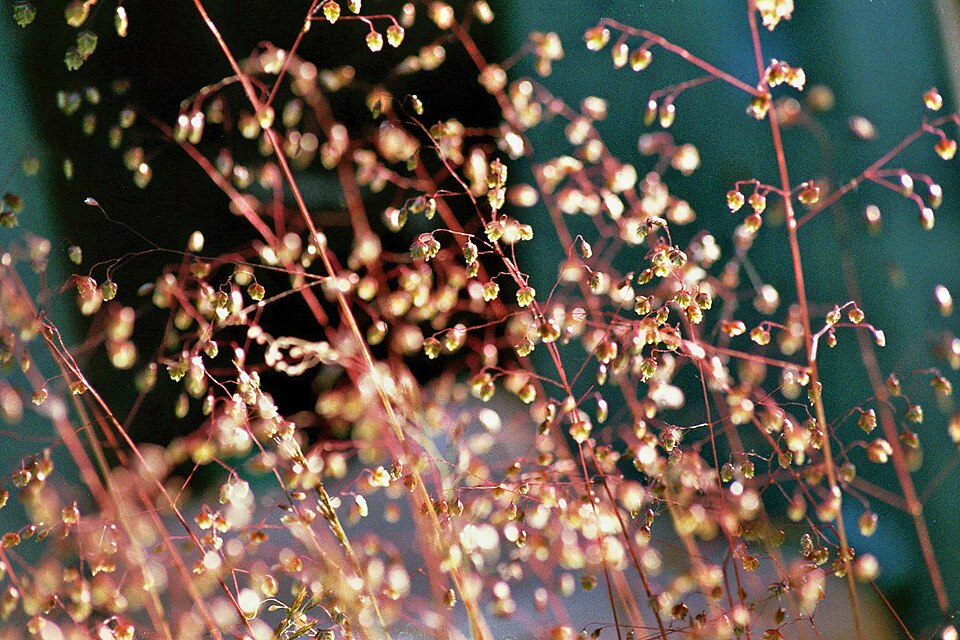
A quaking grass has an effect that disappears if you put it against a row of equally busy plants. Its narrow branches carry small hanging spikelets. In a light breeze those little heads shift independently of the leaves. From a seat on the patio, they can be almost invisible against a bright field of other foliage. Try one container where the light passes through the stems and the background stays relatively quiet. A single plant gives you enough information to decide what to keep outside and how many heads you would like to bring indoors when they dry.
Common quaking grass is Briza media, a perennial. Its seed heads tend to be small and heart-shaped, and the leaves form a lower base. Briza maxima, the taller annual often called greater quaking grass, is a different plant. Advice about its vigorous self-sowing should not be assumed to describe every kind of Briza. Confirm the nursery label and check local planting guidance for common quaking grass, particularly near a sensitive site. In some regions it grows outside its native range. A contained patio arrangement still needs periodic attention to what may have seeded nearby.
Give the spikelets their own background
Put a slim stick at the height of the expected flowering stems and hang a small pale paper mark near its top. The RHS gives a broad mature height range for common quaking grass, often about half a meter to a meter for the stems. Look at the marker from the seat, doorway or path where you want the heads to be seen. Move the empty pot until the upper part is in front of a quiet wall, dark neighboring leaves, or another plain part of the scene. Retain enough sun around its base. A good background placed too close can shade the grass for much of the day.
Look for some protection from strong gusts. The slight movement you see on an ordinary day is different from stems that lean against the wall whenever wind crosses the patio. A site a little inside an outer corner may give the seed heads room to move while reducing the strong wind that pushes a light pot around. Check stability on the surface, especially if you are considering a tall planter. Leave a way to move the pot without catching the stems across a doorway or railing.
If the view is blocked by other pots, try shifting only the foreground pot. Two containers do not have to match height or line up against the wall. The low grass mound and taller flower layer can each be visible when they sit at the edge of a group. Leave a space behind the grass so the stems can extend without scraping the wall. Check shadows again as the season moves toward late spring or summer, when the heads are likely to develop in many temperate regions.
Choose a pot with a useful watering gap
Use a stable container with open drainage holes and a suitably free-draining container mix. The grass may occupy a modest amount of floor space, but it still needs enough root room for a useful clump. Select a size close enough to its root ball that the surrounding mix does not sit wet for an extended period. Give yourself room at the rim to pour water below the leaves. Set the crown at the height it had before and settle the soil around the roots with a thorough watering.
Place the planter where its holes can drain freely, on a level surface or stable pot feet as appropriate. A floor that slopes gently away from the wall can still form a wet pocket under a flat-bottomed pot. After watering, check where the runoff goes so it does not pool at the crown or across a walking surface. If you use a saucer indoors temporarily, empty collected water. The difference between free drainage and standing water can be hard to see once the foliage extends over the rim.
Check moisture in sunny windy weather, when containers can dry faster than nearby ground. Water thoroughly when needed, and allow excess water to escape. An outdoor pot under a wall may miss a shower even while its leaves get wet in the wind. Use your fingers to check the mix near the roots before trusting rainfall alone. At the start of the season, confirm that water reaches the original root ball when you pour. New mix around it may absorb the first water while the inner mass remains dry. A slow second pass can be useful when the original root ball needs it.
Watch the heads without guessing from the calendar
Look at several stems as the first spikelets hang free from their branches. Time varies with climate and growth; the beginning of late spring in one garden may be quite different in another. Compare their color and the way the stems hold them after a breeze. As the heads mature, they can become beige and more noticeable against a dark surface. Keep a note of the stage you liked most. It may be a period in which the small hanging pieces are still green or a point at which the individual heads become visible after drying.
Turn the pot slightly if several good stems are all facing into a neighbor, provided you can move it safely. Some lean is part of the natural shape. If most of the stems are twisting into the same direction, check their light and the strongest wind before attempting to straighten each one. A position farther back from a windy edge may give you several seasons of a better display. If the leaves seem flattened, check that a neighboring plant or repeated traffic is not continually brushing them.
Examine the lower foliage, which may remain partly green in a mild climate. Remove loose dead material when it comes away easily, and work gently near firm new leaves. Use clean tools for old stems and avoid cutting the entire base simply because the seed heads have turned brown. The canopy and the stems above it can finish their seasons at different times. That distinction is useful if you intend to keep the plant visible after flowering.
Use the first arrangement to test the next one
Measure the stems once the heads are dry enough to handle. A short group needs less room and can display the individual spikelets clearly, while a few longer branches allow more air between them. Cut only the ones you plan to use, and shake loose debris over a tray where you can collect it. Handle any spilled seed in a way appropriate to your location instead of carrying it into another garden through old potting material. If you want only a dry display, remove remaining heads before they scatter.
Keep an upright flowering photo and a late season shot from the same viewpoint. The difference will help you decide if next year's position should be brighter or a little farther from the wall. Check the weight of the pot before moving it afterward. A small planter that was easy to lift when it was dry may be awkward after a soak. Give the plant enough room to stay in place when both the pot and the stems are at their least manageable, and the arrangement will be simpler to maintain.
Take several dry stems and decide what stays
For a simple indoor arrangement, choose a few stems with well formed heads while the spikelets are intact. Cut them at a length suited to the intended container. Handle the branches by the lower stem, since the narrow flowering branches are more easily damaged. Lay them on a dry surface or hang them in a dry, ventilated place as appropriate for the arrangement. Leave some stems growing if you still want movement outdoors. Select branches that face into the wall or from an area where taking several will make little difference to the patio view.
If you do not want seedlings, remove maturing flower heads before seed falls. Look around the rim and the nearby gravel where seeds can be hard to see. Volunteer grass seedlings may be difficult to identify when very small, so monitor a defined patch and confirm what you see before spreading the mix or moving it elsewhere. Check local guidance if it is important to prevent escape. In a contained space where a plant is unsuitable for the region, a different locally appropriate grass can give a related effect.
Trim old flower stems later if they are broken or no longer give the shape you wanted. Keep the healthy leaf base and check where new shoots rise before cleaning the pot. Look at the position from your usual seat one last time. If the pale heads were easy to see and the container was easy to water, you have found a useful setting for one clump. There is no need to repeat it across the whole patio. One good background and a little clear space are enough for the movement to show.
Further reading: Royal Horticultural Society profile of common quaking grass.